1. KERENDIA® (finerenone) [prescribing information]. Whippany, NJ: Bayer HealthCare Pharmaceuticals, Inc.; August 2025.
2. Pitt B, et al. N Engl J Med. 2021;385(24):2252-2263.
3. Rossing P, et al. Am J Med. 2022;135(5):576-580.
4. Scirica BM, et al. JAMA Cardiol. 2018;3(2):155-163.
5. Afkarian M, Sachs MC, Kestenbaum B, et al. J Am Soc Nephrol. 2013;24(2):302-308.
6. Raghavan S, et al. J Am Heart Assoc. 2019;8(4):e011295.
7. Stamler J, et al. Diabetes Care. 1993;16(2):434-444.
8. An Y, et al. Diabetes Care. 2015;38(7):1365-1371.
9. Haffner SM, et al. N Engl J Med. 1998;339(4):229-234.
10. American Diabetes Association. Statistics About Diabetes. ADA. Accessed June 12, 2026. https://diabetes.org/about-diabetes/statistics/about-diabetes.
11. Bailey RA, et al. BMC Res Notes. 2014;7:415.
12. American Diabetes Association (Section 11: Chronic kidney disease and risk management: standards of care in diabetes). Diabetes Care. 2025;48(suppl 1):S239-S251.
13. McGill JB, et al. BMJ Open Diabetes Res Care. 2022;10(4):e002806.
14. Fox CS, et al. [Published correction appears in Lancet. 2013;381(9864):374.] Lancet. 2012;380(9854):1662-1673.
15. Inoue K, et al. Ann Epidemiol. 2021;55:15-23.16. de Boer IH, et al. Diabetes Care. 2022;45(12):3075-3090.
17. Morales J, et al. Clin Diabetes. 2023;41(4):553-566.
18. Chaudhuri A, et al. Diabetes Obes Metab. 2022;24(3):365-376.
19. Agarwal R, et al. Eur Heart J. 2022;43(6):474-484.
20. Agarwal R, et al. Supplemental to: Eur Heart J. 2022;43(6):474-484.
21. Grams ME, et al. JAMA. 2023;330(13):1266-1277.
22. Kidney Disease: Improving Global Outcomes® (KDIGO) CKD Work Group. Kidney Suppl. 2013;3(1):1-150.
23. Kidney Disease: Improving Global Outcomes® (KDIGO) Diabetes Work Group. Kidney Int. 2020;98(4S):S1-S115.
24. Alicic RZ, et al. Clin J Am Soc Nephrol. 2017;12(12):2032-2045.
25. Alicic RZ, et al. Adv Chronic Kidney Dis. 2018;25(2):181-191.
26. Ameer OZ. Front Pharmacol. 2022;13:949260.
27. Cade WT. Phys Ther. 2008;88:1322-1335.
28. Bakris GL, et al; FIDELIO-DKD Investigators. N Engl J Med. 2020;383(23):2219-2229.
29. Bakris GL, et al; Supplemental to: FIDELIO-DKD Investigators. N Engl J Med. 2020;383(23):2219-2229.
30. Pitt B, et al. Supplemental to: N Engl J Med. 2021;385(24):2252-2263.
31. Ruilope LM, et al. Nephrol Dial Transplant. 2023;38(2):372-383.
32. Kovesdy CP, et al. Nephron. 2025;149(7):371-383.
33. Data on file. Bayer HealthCare Pharmaceuticals, Inc.; Whippany, NJ.
34. Ruilope LM, et al. Hypertension. 2022;79(12):2685-2695.
35. Ruilope LM, et al. Supplemental to: Hypertension. 2022;79(12):2685-2695.
36. Blazek O. Am Heart J Plus. 2022;19:100187. doi:10.1016/j.ahjo.2022.100187.
37. American Diabetes Association (Section 10: Cardiovascular disease and risk management: standards of care in diabetes). Diabetes Care. 2025;48(suppl 1):S207-S238.
38. Blonde L, et al. Endocr Pract. 2022;28(10):923-1049.
39. Kidney Disease: Improving Global Outcomes® (KDIGO), CKD Work Group. Kidney Int. 2024;105(4S):S117-S314.
40. Marx N, et al. Eur Heart J. 2023;44(39):4043-4140.
41. McDonagh TA, et al. Eur Heart J. 2023;44(37):3627-3639.
42. Data on file. IQVIA NPA. Bayer HealthCare Pharmaceuticals, Inc.; Whippany, NJ.
The prognosis for individuals with T1D and CKD has remained unchanged for 30 years
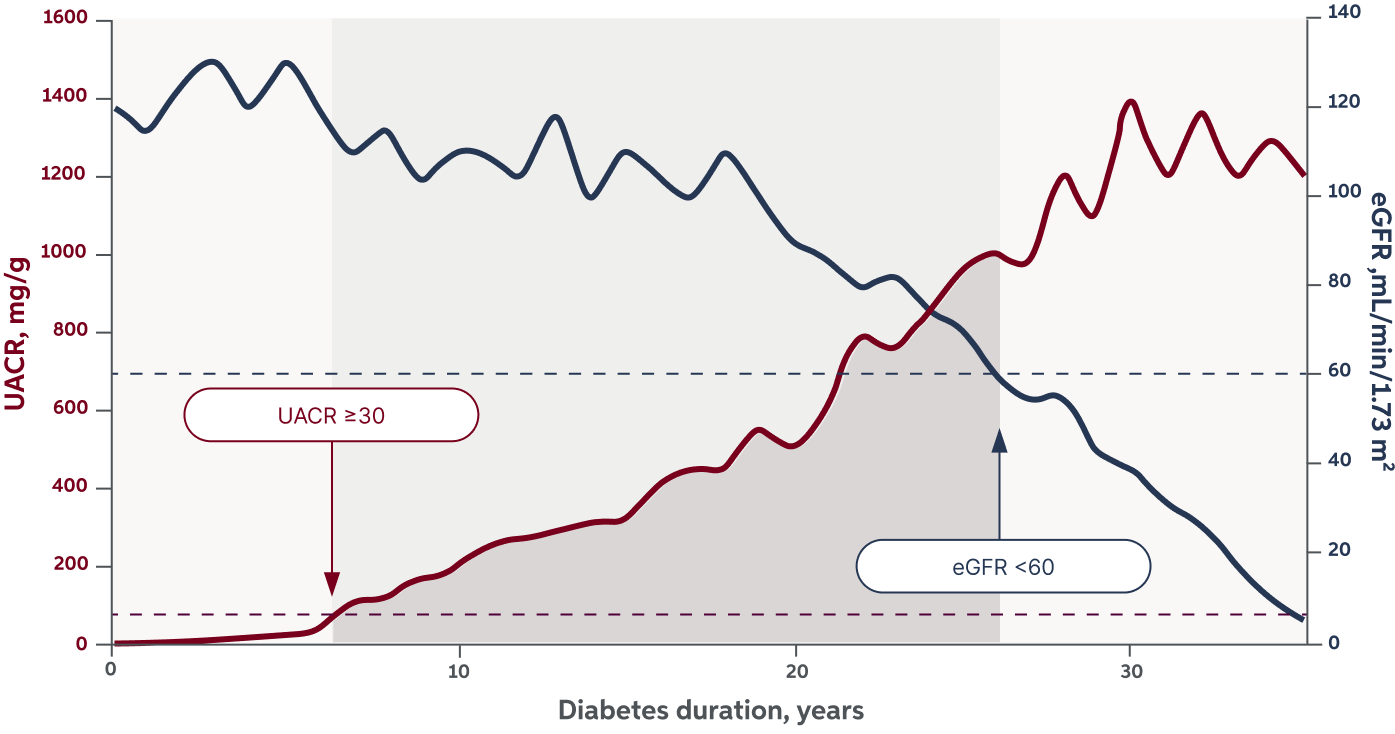
Elevated UACR can detect risk years before eGFR begins to decline
CKD is diagnosed by persistent elevation of UACR (≥30 mg/g)* or eGFR <60 mL/min/1.73 m2 over 3 months
people in the US have T1D
WITH UP TO
7 in 10
developing CKD in their lifetime
UACR is an independent, modifiable risk factor that increases 10-20 years before decline in eGFR*†‡
Vascular damage in the heart and kidneys from a ckd diagnosis can begin as early as
after a T1D diagnosis,
putting patients at risk early in life
Despite being treated with RAS inhibitors as standard of care, patients with T1D experience startling rates of CKD development and progression
Don't wait for eGFR decline when elevated UACR can be addressed today
*Figure adapted from Afkarian M. Pediatr Nephrol. 2015. †UACR and eGFR provide complementary, independent information for cardiovascular risk assessment and should be interpreted together. ‡Based on conceptual model.