1. KERENDIA® (finerenone) [prescribing information]. Whippany, NJ: Bayer HealthCare Pharmaceuticals, Inc.; August 2025.
2. Pitt B, et al. N Engl J Med. 2021;385(24):2252-2263.
3. Rossing P, et al. Am J Med. 2022;135(5):576-580.
4. Scirica BM, et al. JAMA Cardiol. 2018;3(2):155-163.
5. Afkarian M, Sachs MC, Kestenbaum B, et al. J Am Soc Nephrol. 2013;24(2):302-308.
6. Raghavan S, et al. J Am Heart Assoc. 2019;8(4):e011295.
7. Stamler J, et al. Diabetes Care. 1993;16(2):434-444.
8. An Y, et al. Diabetes Care. 2015;38(7):1365-1371.
9. Haffner SM, et al. N Engl J Med. 1998;339(4):229-234.
10. American Diabetes Association. Statistics About Diabetes. ADA. Accessed June 12, 2026. https://diabetes.org/about-diabetes/statistics/about-diabetes.
11. Bailey RA, et al. BMC Res Notes. 2014;7:415.
12. American Diabetes Association (Section 11: Chronic kidney disease and risk management: standards of care in diabetes). Diabetes Care. 2025;48(suppl 1):S239-S251.
13. McGill JB, et al. BMJ Open Diabetes Res Care. 2022;10(4):e002806.
14. Fox CS, et al. [Published correction appears in Lancet. 2013;381(9864):374.] Lancet. 2012;380(9854):1662-1673.
15. Inoue K, et al. Ann Epidemiol. 2021;55:15-23.16. de Boer IH, et al. Diabetes Care. 2022;45(12):3075-3090.
17. Morales J, et al. Clin Diabetes. 2023;41(4):553-566.
18. Chaudhuri A, et al. Diabetes Obes Metab. 2022;24(3):365-376.
19. Agarwal R, et al. Eur Heart J. 2022;43(6):474-484.
20. Agarwal R, et al. Supplemental to: Eur Heart J. 2022;43(6):474-484.
21. Grams ME, et al. JAMA. 2023;330(13):1266-1277.
22. Kidney Disease: Improving Global Outcomes® (KDIGO) CKD Work Group. Kidney Suppl. 2013;3(1):1-150.
23. Kidney Disease: Improving Global Outcomes® (KDIGO) Diabetes Work Group. Kidney Int. 2020;98(4S):S1-S115.
24. Alicic RZ, et al. Clin J Am Soc Nephrol. 2017;12(12):2032-2045.
25. Alicic RZ, et al. Adv Chronic Kidney Dis. 2018;25(2):181-191.
26. Ameer OZ. Front Pharmacol. 2022;13:949260.
27. Cade WT. Phys Ther. 2008;88:1322-1335.
28. Bakris GL, et al; FIDELIO-DKD Investigators. N Engl J Med. 2020;383(23):2219-2229.
29. Bakris GL, et al; Supplemental to: FIDELIO-DKD Investigators. N Engl J Med. 2020;383(23):2219-2229.
30. Pitt B, et al. Supplemental to: N Engl J Med. 2021;385(24):2252-2263.
31. Ruilope LM, et al. Nephrol Dial Transplant. 2023;38(2):372-383.
32. Kovesdy CP, et al. Nephron. 2025;149(7):371-383.
33. Data on file. Bayer HealthCare Pharmaceuticals, Inc.; Whippany, NJ.
34. Ruilope LM, et al. Hypertension. 2022;79(12):2685-2695.
35. Ruilope LM, et al. Supplemental to: Hypertension. 2022;79(12):2685-2695.
36. Blazek O. Am Heart J Plus. 2022;19:100187. doi:10.1016/j.ahjo.2022.100187.
37. American Diabetes Association (Section 10: Cardiovascular disease and risk management: standards of care in diabetes). Diabetes Care. 2025;48(suppl 1):S207-S238.
38. Blonde L, et al. Endocr Pract. 2022;28(10):923-1049.
39. Kidney Disease: Improving Global Outcomes® (KDIGO), CKD Work Group. Kidney Int. 2024;105(4S):S117-S314.
40. Marx N, et al. Eur Heart J. 2023;44(39):4043-4140.
41. McDonagh TA, et al. Eur Heart J. 2023;44(37):3627-3639.
42. Data on file. IQVIA NPA. Bayer HealthCare Pharmaceuticals, Inc.; Whippany, NJ.
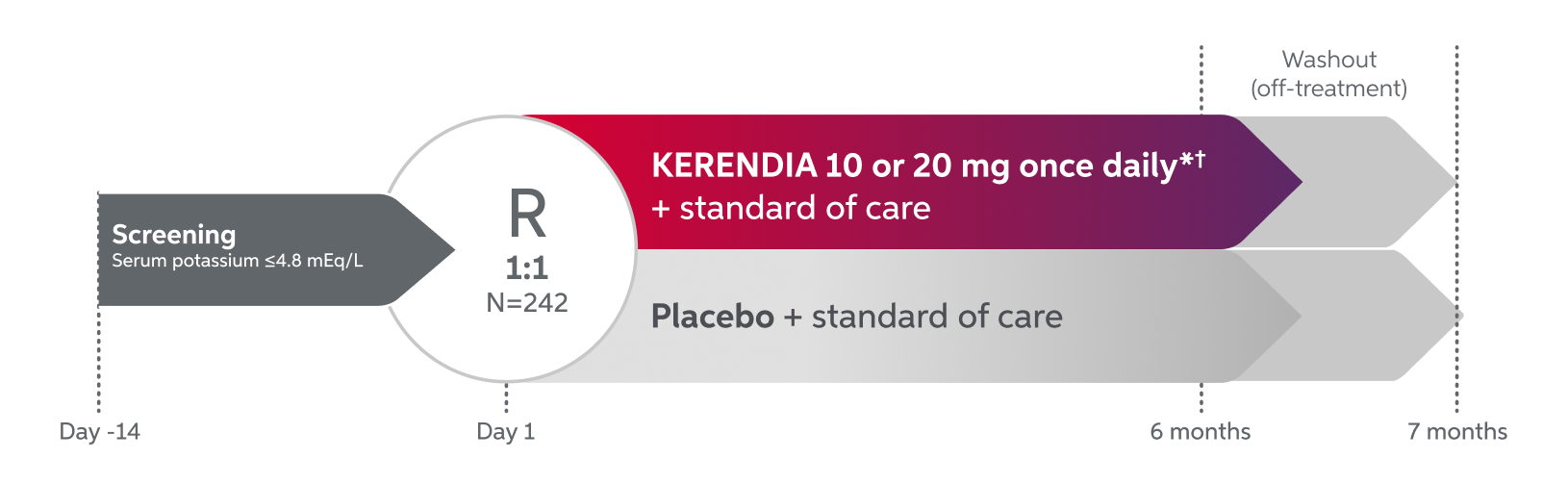
FINE-ONE: A pioneering phase 3 clinical trial evaluating KERENDIA in patients with T1D and CKD
In FINE-ONE, a randomized, double-blind, placebo-controlled trial, KERENDIA was evaluated when added to a maximum-tolerated dose of an ACEi or ARB in adults with CKD associated with T1D
Primary outcome: efficacy
Change in UACR from baseline over 6 months
Secondary outcomes: safety
TEAEs or serious TEAEs from baseline to 7 months
Hyperkalemia (an AE of special interest) from baseline to 7 months
Criteria and characteristics
*On top of a maximum-tolerated dose of either an ACEi or ARB. †For participants with an eGFR ≥25 to <60 mL/min/1.73 m², starting dose is 10 mg od. For participants with an eGFR ≥60 mL/min/1.73 m², starting dose is 20 mg od. Up-titration and down-titration of study intervention will be based on local serum [K+] and kidney function (eGFR) values.
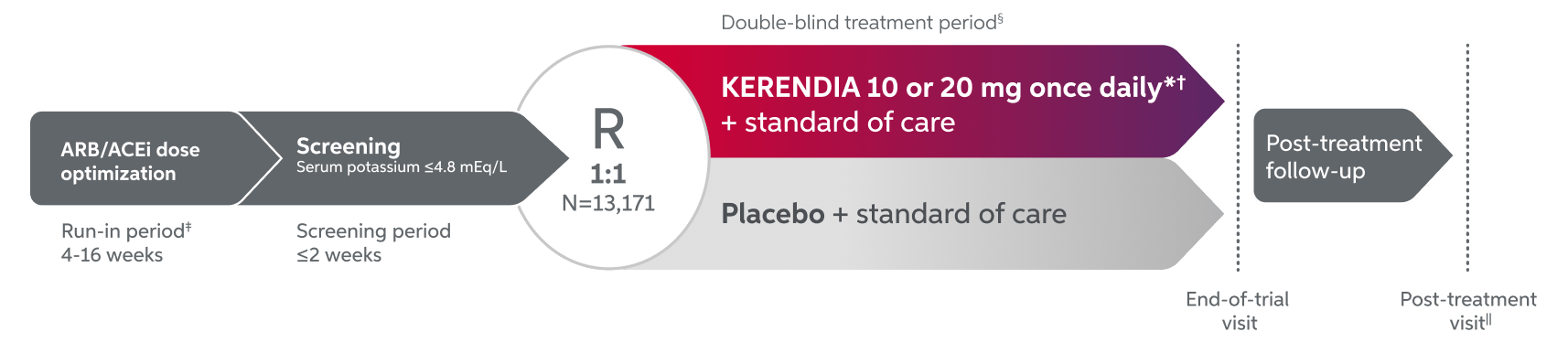
FIGARO-DKD and FIDELIO-DKD shared similar designs1,2,19,28,29
*On top of maximum-tolerated dose of either ACEi or ARB.2,28†Up-titration of study drug was encouraged after visit 2, provided potassium value was ≤4.8 mEq/L and eGFR was stable; down-titration was allowed any time after treatment initiation for safety reasons.29,30‡The purpose of the mandatory run-in period was to allow for optimization of participant standard-of-care medical therapies. This included ensuring that a patient was pretreated with a maximum-tolerated labeled dose of either an ACEi or an ARB (preferably without dose adjustments or switching to a different ACEi or ARB) for >4 weeks prior to the screening visit.29,30§Visits at month 1, month 4, and every 4 months thereafter.2,28II4 weeks and 5 days after last dose.29,30
Mean BP >160/100 mmHg or mean systolic BP <90 mmHg at screening
Hospitalization due to a CV event ≤4 weeks prior to screening
Symptomatic heart failure with reduced ejection fraction with class 1A indications for MRAs
Current or previous (≤8 weeks prior to screening) treatment with a SGLT-2/1i or GLP-1RA eplerenone, spironolactone, canrenone, esaxerenone, any renin inhibitor, or sacubitril/valsartan
Select baseline characteristics
Mean age: 51.6 ± 13.7
Male, n (%): 158 (65.3)
BMI, kg/m2, mean ± SD*: 27.6 ± 6.0
Systolic BP, mm hg: 135.2 ± 16.7
eGFR, mL/min/1.73 m2, mean ± SD: 58.8 ± 19.1
UACR, mg/g, median (IQR): 549.0 (298.8-1190.7)
Serum [K+], mmol/L, mean: 4.6 ± 0.4
HbA1c, %, mean‡: 7.6 ± 1.1
Duration of diabetes, years, mean: 32.0 ± 14.2
CVD, n (%)§: 59 (24.4)
Hypertension, n (%): 207 (85.5)
ACEi or ARBs: 240 (99.2)
Diuretics: 87 (36.0)
Beta blockers: 66 (27.3)
Statins: 178 (73.6)
Platelet aggregation inhibitors: 76 (31.4)
Renal outcomes trial1,28
FIDELIO-DKD (N=5674)
Primary composite renal endpoint
Secondary composite CV endpoint
Select inclusion criteria1
UACR of 30 to <300 mg/g, eGFR of 25 to <60 mL/min/1.73 m2, and diabetic retinopathy or UACR of ≥300 mg/g and eGFR of 25 to <75 mL/min/1.73 m2
Select exclusion criteria1
Other conditions:
Symptomatic chronic HF with reduced ejection fraction (NYHA class II-IV)
Known significant nondiabetic kidney disease
Select baseline characteristics28
Median UACR of 852 mg/g
Mean eGFR of 44.3 mL/min/1.73 m2
*Data were missing for one participant in each group. †Race or ethnic group was reported by the participants. Two participants in the finerenone group were Native American or Native Alaskan, and race or ethnic group was not reported for one participant in each group. ‡Data were missing for two participants in the placebo group. §A history of cardiovascular disease was determined by the presence of one of the following in the medical history: myocardial infarction, coronary-artery stenosis, stroke, transient ischemic attack, peripheral arterial occlusive disease, or cardiac failure. IIUse of sodium–glucose cotransporter 2 inhibitors and glucagon-like peptide-1 receptor agonists was not permitted in the trial. Note: Percentages may not total 100 because of rounding.
KERENDIA for CKD associated with T2D: efficacy and safety overview
FIGARO-DKD1,2
13%RRR
Primary CV composite endpoint1,2
On top of standard of care, 13% RRR vs placebo, HR=0.87 (95% CI: 0.76-0.98), P=0.026
32%placebo- corrected RR
Exploratory analysis1
UACR reduction relative to placebo on top of standard of care: 32% (95% CI: 30-35%), at month 4
Secondary renal composite endpoint1,2
The key secondary composite of kidney failure, sustained eGFR decline of ≥40%, or renal death occurred in 350 patients in the KERENDIA group (9.5%) and 395 patients in the placebo group (10.8%) (HR=0.87 [95% Cl: 0.76-1.01]). The difference was not statistically significant
FIDELIO-DKD1
18%RRR
Primary renal composite endpoint1
On top of standard of care, 18% RRR vs placebo, HR=0.82 (95% CI: 0.73-0.93), P=0.001
31%placebo- corrected RR
Exploratory analysis1
UACR reduction relative to placebo on top of standard of care: 31% (95% CI: 29-34%), at month 4
14%RRR
Secondary CV composite endpoint1
On top of standard of care, 14% RRR vs placebo, HR=0.86 (95% CI: 0.75-0.99), P=0.034
Safety: pooled data FIGARO-DKD and FIDELIO-DKD1
Adverse reactions reported in ≥1% of patients taking KERENDIA and more common than placebo
Hyperkalemia: 14% (KERENDIA: n=912/6510) vs 6.9% (placebo: n=448/6489)
Hypotension: 4.6% (KERENDIA: n=302/6510) vs 3.0% (placebo: n=194/6489)
Hyponatremia: 1.3% (KERENDIA: n=82/6510) vs 0.7% (placebo: n=47/6489)