1. KERENDIA® (finerenone) [prescribing information]. Whippany, NJ: Bayer HealthCare Pharmaceuticals, Inc.; August 2025.
2. Pitt B, et al. N Engl J Med. 2021;385(24):2252-2263.
3. Rossing P, et al. Am J Med. 2022;135(5):576-580.
4. Scirica BM, et al. JAMA Cardiol. 2018;3(2):155-163.
5. Afkarian M, Sachs MC, Kestenbaum B, et al. J Am Soc Nephrol. 2013;24(2):302-308.
6. Raghavan S, et al. J Am Heart Assoc. 2019;8(4):e011295.
7. Stamler J, et al. Diabetes Care. 1993;16(2):434-444.
8. An Y, et al. Diabetes Care. 2015;38(7):1365-1371.
9. Haffner SM, et al. N Engl J Med. 1998;339(4):229-234.
10. American Diabetes Association. Statistics About Diabetes. ADA. Accessed June 12, 2026. https://diabetes.org/about-diabetes/statistics/about-diabetes.
11. Bailey RA, et al. BMC Res Notes. 2014;7:415.
12. American Diabetes Association (Section 11: Chronic kidney disease and risk management: standards of care in diabetes). Diabetes Care. 2025;48(suppl 1):S239-S251.
13. McGill JB, et al. BMJ Open Diabetes Res Care. 2022;10(4):e002806.
14. Fox CS, et al. [Published correction appears in Lancet. 2013;381(9864):374.] Lancet. 2012;380(9854):1662-1673.
15. Inoue K, et al. Ann Epidemiol. 2021;55:15-23.16. de Boer IH, et al. Diabetes Care. 2022;45(12):3075-3090.
17. Morales J, et al. Clin Diabetes. 2023;41(4):553-566.
18. Chaudhuri A, et al. Diabetes Obes Metab. 2022;24(3):365-376.
19. Agarwal R, et al. Eur Heart J. 2022;43(6):474-484.
20. Agarwal R, et al. Supplemental to: Eur Heart J. 2022;43(6):474-484.
21. Grams ME, et al. JAMA. 2023;330(13):1266-1277.
22. Kidney Disease: Improving Global Outcomes® (KDIGO) CKD Work Group. Kidney Suppl. 2013;3(1):1-150.
23. Kidney Disease: Improving Global Outcomes® (KDIGO) Diabetes Work Group. Kidney Int. 2020;98(4S):S1-S115.
24. Alicic RZ, et al. Clin J Am Soc Nephrol. 2017;12(12):2032-2045.
25. Alicic RZ, et al. Adv Chronic Kidney Dis. 2018;25(2):181-191.
26. Ameer OZ. Front Pharmacol. 2022;13:949260.
27. Cade WT. Phys Ther. 2008;88:1322-1335.
28. Bakris GL, et al; FIDELIO-DKD Investigators. N Engl J Med. 2020;383(23):2219-2229.
29. Bakris GL, et al; Supplemental to: FIDELIO-DKD Investigators. N Engl J Med. 2020;383(23):2219-2229.
30. Pitt B, et al. Supplemental to: N Engl J Med. 2021;385(24):2252-2263.
31. Ruilope LM, et al. Nephrol Dial Transplant. 2023;38(2):372-383.
32. Kovesdy CP, et al. Nephron. 2025;149(7):371-383.
33. Data on file. Bayer HealthCare Pharmaceuticals, Inc.; Whippany, NJ.
34. Ruilope LM, et al. Hypertension. 2022;79(12):2685-2695.
35. Ruilope LM, et al. Supplemental to: Hypertension. 2022;79(12):2685-2695.
36. Blazek O. Am Heart J Plus. 2022;19:100187. doi:10.1016/j.ahjo.2022.100187.
37. American Diabetes Association (Section 10: Cardiovascular disease and risk management: standards of care in diabetes). Diabetes Care. 2025;48(suppl 1):S207-S238.
38. Blonde L, et al. Endocr Pract. 2022;28(10):923-1049.
39. Kidney Disease: Improving Global Outcomes® (KDIGO), CKD Work Group. Kidney Int. 2024;105(4S):S117-S314.
40. Marx N, et al. Eur Heart J. 2023;44(39):4043-4140.
41. McDonagh TA, et al. Eur Heart J. 2023;44(37):3627-3639.
42. Data on file. IQVIA NPA. Bayer HealthCare Pharmaceuticals, Inc.; Whippany, NJ.
For your adult patients with CKD associated with T1D
CHANGE THE COURSE
BY REDUCING UACR
After more than three decades without advancement, KERENDIA is moving care forward in CKD in T1D. KERENDIA significantly reduces UACR, an independent marker of CKD progression risk.
Act on elevated UACR
Elevated UACR can signal systemic damage and increased risk of CKD progression in adults with T1D
Proven efficacy
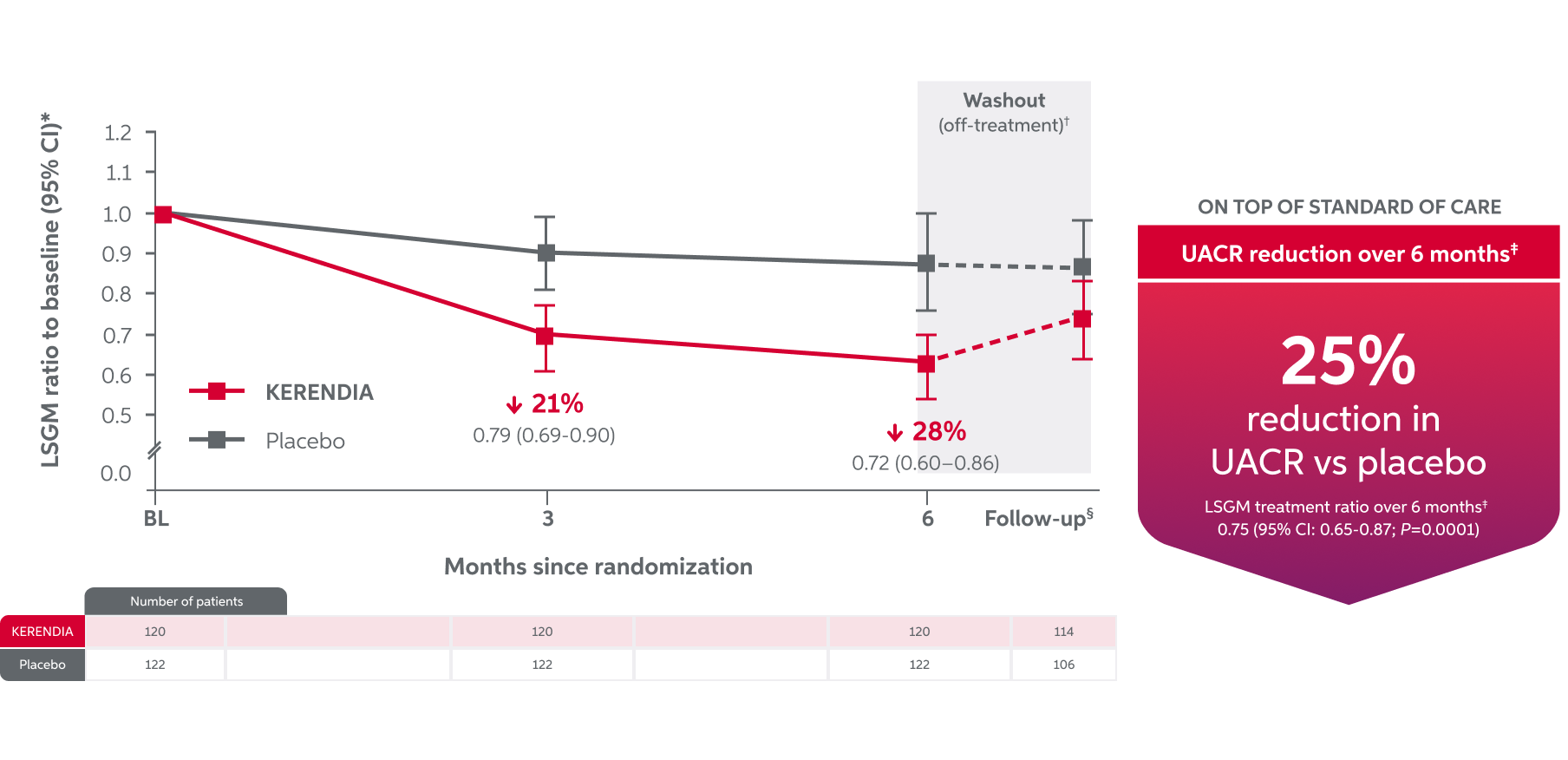
KERENDIA delivered a significant 25% greater reduction in UACR vs placebo over 6 months in adults with CKD associated with T1D
UACR data
Routinely prescribed
More than 330,000 patients have been treated with KERENDIA
KERENDIA is the first proven treatment for CKD associated with T1D in more than 30 years
KERENDIA significantly reduced UACR vs placebo on top of standard of care
Reductions in UACR were observed as early as Month 3 and were sustained through Month 6
*Up to 3 daily UACR measures were combined into a geometric mean UACR prior to the analysis of the ratio to baseline of geometric mean UACR. †Assessment of data for the washout period was conducted using an ANCOVA model for the ratio to baseline in UACR at follow-up with the model including log baseline UACR. ‡Geometric mean ratio of treatment group ratios to baseline over the study period (ie, average of geometric mean of treatment effect at month 3 and month 6 visits). §30 days after last dose of study intervention.
of real-world experience in CKD associated with T2D, with reach expanding since approval in HF LVEF ≥40% in 2025 and CKD associated with T1D in 20261
Over
65,000
prescribing HCPs31*
More than
330,000
patients treated31*
KERENDIA is recommended in 4 leading guidelines including ADA, KDIGO, AACE, and ESC
Treatment strategy is based upon individual patient needs and physician discretion.
Recommendations with an A rating are based on large, well-designed clinical trials or well-done meta-analyses. Generally, these recommendations have the best chance of improving outcomes when applied to the population to which they are appropriate. Level 1A recommendations are based on a randomized, controlled clinical trial. Level 2A recommendations are based on secular trends, such as those from correlational studies.
*IQVIA NPA data, July 2021 to March 2026. Treatments are normalized for 30-day scripts.31
AACE=American Association of Clinical Endocrinology; ADA=American Diabetes Association; CKD=chronic kidney disease; ESC=European Society of Cardiology; HCP=healthcare professional; HF LVEF=heart failure with left ventricular ejection fraction; KDIGO=Kidney Disease: Improving Global Outcomes; NPA=National Prescription Audit; T1D=type 1 diabetes; T2D=type 2 diabetes.